


Infamous Sci Fi TV Cancellations: This ongoing series looks back at some of the most notorious cancellations of sci fi and fantasy TV shows by the broadcast networks, cable channels, and streaming services.
What Is It?
This series follows Prairie Johnson, a young blind woman who mysteriously reappears after being missing for seven years, having somehow regained her sight. Calling herself “The OA,” she gathers a group of strangers and recounts her experiences involving captivity, near-death experiences, and experiments that suggest the existence of alternate dimensions.
Aired: Netflix, 2016-19, 2 Seasons Totaling 16 Episodes
Starring: Brit Marling, Emory Cohen, Scott Wilson, Phyllis Smith, Alice Krige
Created By: Brit Marling, Zal Batmanglij
Why Was It Cancelled?
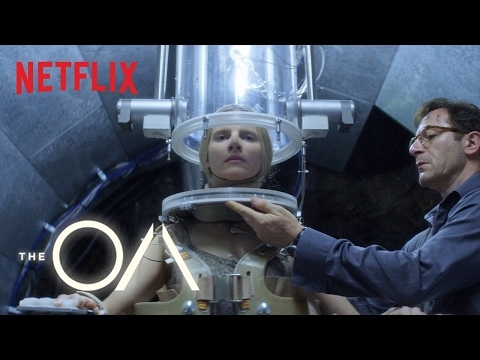
The OA premiered on Netflix at a time when that service was ramping up its original content to compete for the television audience that was dominated by the broadcast networks and cable channels. It arrived with little fanfare, but slowly built up a following through good word-of-mouth, especially when it returned for its second season. And while that streamer typically allowed its shows to go three to four seasons and wrap up their storylines, Netflix execs decided to cancel The OA after its second year, leaving a significant part of its story untold. No official viewing numbers for the show have been revealed, and the streamer never gave a specific reason for the cancellation. But series regular Jason Isaacs claimed that it was not viewership that killed the show:
Netflix needs to build subscribers and they make their decisions on a bunch of other things, which are not to do with the number of people watching, more to do with how many people they can get to sign up. I know the Netflix execs who made the decision to cancel it felt equally sad because they had five seasons mapped out and the show has this rabid committed fanbase. Those people felt very upset. I wouldn’t want to be sitting in the Netflix executive chairs!
There were theories that the cancellation was fake and that it was part of a publicity stunt worked in with the conspiracy themes of the show. But those proved not to be the case, and the show ended well short of its plan five-season arc.
Upon the announcement, fans immediately took up a call to action to save the show. Netflix had cancelled the sci fi series Sense8 two years prior after two seasons, and a raucous fan campaign led to a two-hour finale movie for the show. Fans of The OA hoped for at least the same and got the show trending on social media while also raising money to put up a billboard in Times Square lobbying for the show to continue. They also staged a flashmob and even a hunger strike to show their support for the cancelled series. Creators Brit Marling and Zal Batmanglij had conversations with Netflix about a final movie, but they did not believe that would do justice to the story. Marling had the following to say to fans in an Instagram post:
Your words and images move us deeply. Not because the show must continue, but because for some people its unexpected cancellation begs larger questions about the role of storytelling and its fate inside late capitalism’s push toward consolidation and economies of scale.
Fans continued to lobby for the show, staging one of the more active campaigns for a cancelled series, but Netflix could not be swayed to bring it back for a third season.
Should It Have Continued?

It definitely should have continued because there was more story to tell, and the show was truncated on an unsatisfying ending. As mentioned, a five-season arc was planned for the series meaning that it was not a good fit for that streamer’s model. Netflix typically allowed its originals to go three to four years, and the story planned for The OA would have pushed beyond that. If it had managed to stick around to a fourth season, perhaps the creative team could have wrapped up things up, but it was cut short well before that.
Nielsen was not putting out its streaming rankings at that point, and Netflix was not sharing viewership numbers, but all indications are that while The OA has a dedicated audience, it was not one of the higher viewership shows on the service. And this was one of the early cancellaton victims as the streamer began to change its stance towards its originals. In 2017, Netflix’s CEO Reed Hastings made the comment that the service should have a higher cancellation rate:
Our hit ratio is way too high right now. So, we’ve canceled very few shows … I’m always pushing the content team: We have to take more risk; you have to try more crazy things. Because we should have a higher cancel rate overall.
And sure enough, two years later, The OA was cancelled leaving many fans disappointed as corporate management moved away from its more supportive stance towards its originals.
Where Does the Property Stand Now?
Netflix usually retains the rights to a property for about two years, but since this show was made by Netflix Studios, it appears that they still control it and may not be willing to let it move to another venue. And it has been seven years since the show was cancelled, so it seems like returning to it after that long of a gap would be difficult. However, as recently as one year ago, series star Jason Issaacs said in an interview that himself and creators Brit Marling and Zal Batmanglij had agreed to do “whatever it takes” to bring the show back, so perhaps it is not dead yet. It certainly seems like a longshot, but if fans were to make another push and the cast and crew got behind them, maybe they could convince Netflix to bring the show back and allow it to wrap up its storylines.
Where Can You Watch It?
As mentioned above, the show is still streaming on Netflix, and that is currently the only place it is available.
Why Were They Cancelled? 2nd Ed.


What happened to it? Where did it go? Why were no more episodes produced? Will the story ever be resolved?
The answer to what happened is simple: it got cancelled. And it was cancelled because viewership did not meet expectations, whether that was measured by the Nielsen ratings or whatever metric the network or streaming service uses to gauge its audience.
But why was the viewership low, you ask? It was such a great show and more people should have been tuning in. Why didn’t its network do more to promote it? And why do the companies that produce and air television shows seem to hate sci fi and fantasy so much?
These are questions genre fans have been asking for years, and Why Were They Cancelled? is here to provide some answers. This is the updated and expanded second edition of the book, and it looks at the era of the Nielsen ratings and how that is becoming a thing of the past while also focusing on the more recent impacts of the streaming services and Peak TV.